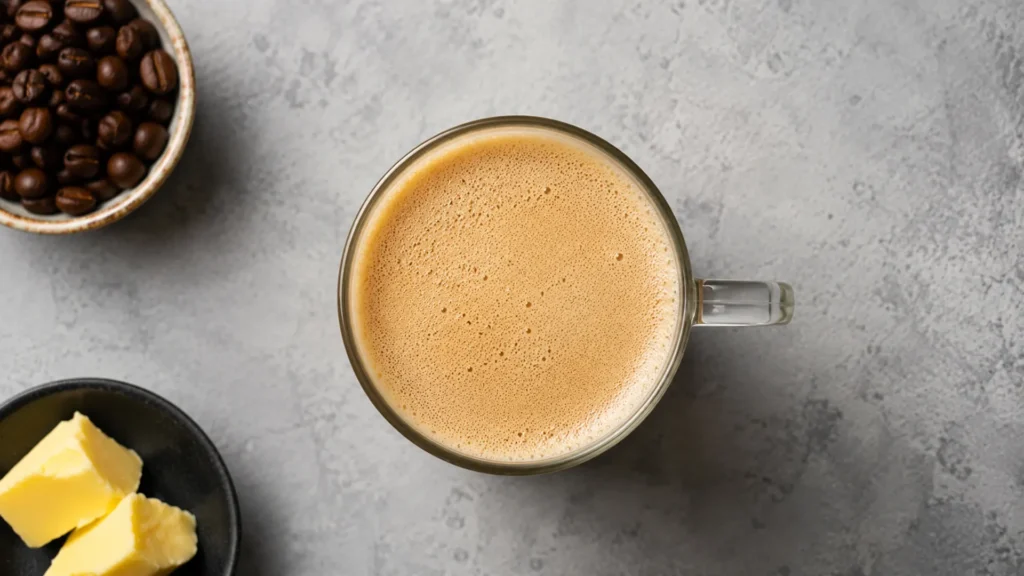
Keto coffee is hot brewed coffee blended with added fat, usually some mix of butter, MCT oil, coconut oil, ghee, or heavy cream, so the drink carries almost no carbs and a real load of energy. That is the whole idea. You take a zero-carb base, coffee, and you turn it into a fat-forward breakfast in a cup. A standard mug runs about 1 gram of net carbs and 130 to 230 calories depending on how much fat you add, which is why it slots cleanly into a morning when you want fuel but not food. It keeps you in ketosis, blunts hunger for a few hours, and replaces the sugary creamer habit that quietly wrecks more keto runs than any plate of pasta.
Most keto coffee recipes hand you a four-line ingredient list and a blender and call it done. That is the gap. They skip the part where the oil floats in a greasy slick, the part where you cannot tell butter from MCT for your goal, and the part where you wonder if the thing just broke your fast. So this guide gives you the base recipe with real macros, a fat-source table so you pick on purpose, the blending physics that stop separation, a troubleshooting section for when it goes wrong, an iced version, and a straight answer on fasting. If you want the macro targets behind all of it, the keto diet guidelines show where the percentages come from.
What keto coffee actually is
Strip away the branding and keto coffee is one move: emulsify fat into hot coffee so it drinks like a creamy latte instead of a slick of oil on black coffee. The fat is the point. On a ketogenic diet you run on fat for fuel, so a drink that delivers 12 to 25 grams of fat with near-zero carbs is a tidy way to start the day without spiking insulin. The popular name “bulletproof coffee” comes from one branded version built on butter plus MCT oil, but the category is older and broader than any one brand. Any coffee plus a keto-friendly fat, blended, qualifies.
What it is not is a magic fat-burner. The coffee does not melt body fat and the butter does not have special powers. What it does is honest and useful: it gives you steady energy, it kills the morning hunger that sends people to a muffin, and it carries caffeine, which on its own raises alertness and modestly lifts metabolic rate. Add fat to that caffeine and you get a drink that holds you to lunch on most days. People who struggle with breakfast, or who fast through the morning and want something in the cup, are the ones who get the most out of it. If you eat a full keto breakfast already, you may not need the calories at all, which matters when weight loss is the goal.
The base recipe and macros
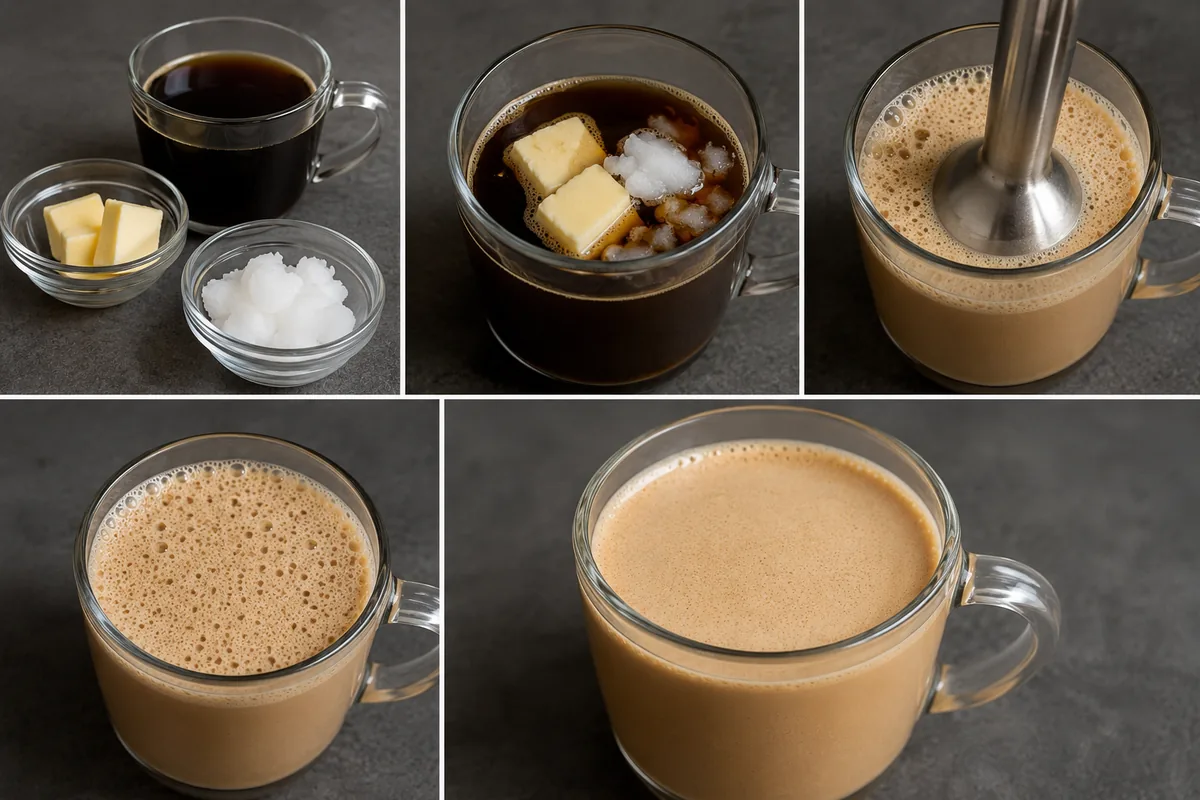
Here is the standard version. It is deliberately middle-of-the-road: creamy, filling, not a calorie bomb. Scale the fat up or down once you know your goal, as covered below.
Start with 1 cup (8 to 10 ounces) of hot brewed coffee. Add 1 tablespoon of unsalted butter, 1 tablespoon of MCT oil or coconut oil, and 1 tablespoon of heavy cream. Blend for 20 to 30 seconds until it is foamy and uniform with no oil ring on top. That is it. The blending is not optional, which is the single thing the four-line recipes underplay, and the method section explains why.
| Per 1 cup (base recipe) | Amount |
|---|---|
| Calories | about 230 |
| Net carbs | about 1 gram |
| Protein | about 1 gram |
| Total fat | about 25 grams |
| Caffeine | about 95 mg (from 1 cup drip) |
The single net carb comes almost entirely from the heavy cream, since coffee itself is effectively zero and pure fats carry no carbs. Drop the cream and you drop to a fraction of a gram. That 1 gram is rounding noise against a 20 to 50 gram daily budget, so keto coffee is one of the cheapest drinks you can buy in carb terms. The number that actually matters here is calories. At 230 a cup, two of these before noon is 460 calories of pure fat, which is fine on a maintenance day and a real problem on a cut. Treat keto coffee as a meal, not a beverage, and the math stays honest.
Choosing your fat: butter vs MCT vs coconut vs ghee vs heavy cream
This is the choice the top recipes skip, and it is the one that changes how the drink works for you. All of these fats are zero or near-zero carbs, so you are not choosing on carb count. You are choosing on what the fat does: how fast it converts to ketones, how it tastes, and how it behaves in the cup. Here is how they stack up.
| Fat source | Net carbs (1 tbsp) | Calories (1 tbsp) | Flavor and best use |
|---|---|---|---|
| Grass-fed butter | 0 g | about 100 | Rich, savory, classic base; adds body and a buttery top note |
| MCT oil | 0 g | about 115 | Neutral; fastest to ketones; start small or it upsets the gut |
| Coconut oil | 0 g | about 120 | Light coconut flavor; cheaper MCT substitute; slower conversion |
| Ghee | 0 g | about 120 | Nutty, deeper than butter; no milk solids, easier on the stomach |
| Heavy cream | about 0.4 g | about 50 | Creamy mouthfeel; lower calorie per tbsp; the latte-like option |
My default is butter plus a teaspoon of MCT, because butter gives the body and MCT gives the fast clean energy without much flavor. MCT oil is the one to respect: it converts to ketones faster than any other fat here, which is the draw, but a full tablespoon on day one will send a beginner to the bathroom. Start at a teaspoon and build up over a week. Healthline has a solid rundown on how MCT oil is metabolized if you want the mechanism behind why it hits faster than coconut oil, which only contains part MCTs.
Ghee is the move if dairy bothers you, since clarifying removes the milk solids. Heavy cream is the move if you want the lowest-calorie, most latte-like cup, because at roughly 50 calories a tablespoon it costs half what the oils do and still drinks rich. Coconut oil is the budget MCT stand-in, fine if you like a whisper of coconut. There is no single right answer, only the right answer for your goal and your gut.
How to blend it right
The difference between a creamy keto coffee and a greasy one is emulsification, and emulsification needs force. When you stir oil into coffee with a spoon, the fat just pools and floats, because oil and water do not mix on their own. Blending fixes this by shearing the fat into droplets so small they stay suspended in the water, which is the same physics that makes mayonnaise hold or milk look uniform. Get the emulsion and the drink is smooth and frothy with no slick. Skip it and you are drinking oil on top of coffee, which both tastes bad and sits heavy.
A high-speed blender is the gold standard. Pour the hot coffee in first, add the fats, secure the lid with a towel over it (hot liquid expands and can blow the lid), and run it for 20 to 30 seconds until you see a stable foam cap and no separation. An immersion blender in a tall cup works almost as well and means one less thing to wash. A handheld milk frother is the weakest option: it will froth the surface but it does not generate enough shear to fully emulsify a tablespoon of oil, so use it only for cream-based versions with little or no oil. A shaker bottle does not cut it for oil at all.
Brew the base well first
Good keto coffee starts with good coffee, because the fat amplifies whatever is in the cup, including bitterness from a bad brew. Use freshly ground beans and water just off the boil, around 200 degrees, and do not let it sit on a burner going stale. The folks at America’s Test Kitchen have tested brew ratios and water temperature exhaustively, and the short version is that a 1 to 16 ratio of coffee to water and clean filtered water do more for flavor than any gadget. Get the base right and the blended drink tastes like a treat instead of a chore.
Troubleshooting greasy or separated coffee

When keto coffee goes wrong, it almost always goes wrong in one of three ways, and each has a fix. This is the section the recipe blogs skip, and it is the one that keeps people drinking the stuff past week one.
Greasy mouthfeel or an oil slick on top means the emulsion broke or never formed. The cause is almost always too little blending or too much oil. Blend longer, a full 30 seconds, and cut the oil back to start. If you are using a frother, switch to a real blender. The slick is unblended fat, plain and simple, and more force is the answer.
Separation after a few minutes, where the drink looks fine then goes oily as it sits, means the emulsion is unstable. Heavy cream or a teaspoon of butter helps here because the milk proteins and lecithin act as emulsifiers that hold the oil in suspension longer. A version built on MCT oil alone separates fastest, so if you drink slowly, add cream. An upset stomach or loose stool after drinking is the classic MCT overdose: you went too high too fast. Drop back to a teaspoon and rebuild tolerance over a week or two. Finally, if the drink leaves you jittery, you stacked too much caffeine; this is a coffee problem, not a fat problem, so brew it weaker or use half-caf. None of these are reasons to quit, they are dials to turn.
Iced and flavored versions
Hot is the default but iced keto coffee is better in summer and just as easy, with one trick: blend hot, then pour over ice, or the fat will seize into little solid flecks if you blend it cold. So brew a strong cup, or use cooled coffee warmed slightly, blend the fats in while it is still warm enough to stay liquid, then pour the smooth blend over a glass of ice. The emulsion holds and you get a cold, creamy drink with the same near-zero carbs. For a true cold brew base, blend the fat with a splash of hot water first to emulsify, then add the cold brew.
Flavor is where keto coffee stops feeling like a supplement and starts feeling like a drink you want. A few drops of sugar-free vanilla, a pinch of cinnamon, a spoon of unsweetened cocoa powder for a mocha, or a keto-approved sweetener like a little erythritol or allulose all blend right in for zero or trace carbs. Skip the maltitol-based syrups, which raise blood sugar and do not subtract cleanly as net carbs. A pinch of salt sounds odd but it rounds out bitterness and quietly adds the sodium most keto dieters run short on. If you want the coffee to actually anchor a meal rather than just tide you over, pair it with something from the keto breakfast ideas so you are not running on fat and caffeine alone.
Dial the ratio to your macro goal
The base recipe is a starting point, not a law. On a high-fat day or an intense-training day, push to 2 tablespoons of butter plus a tablespoon of MCT and let the cup carry 350 calories of fuel. On a cut, strip it down to a single tablespoon of heavy cream and a teaspoon of MCT, which lands near 120 calories and still drinks rich, so it spends less of your day’s budget. The carbs barely move in either direction; calories are the lever. Match the cup to the day and keto coffee works for fat loss and maintenance both, instead of quietly stalling you with calories you did not count.
Does keto coffee break a fast
This is the question everyone asks and the answer depends on what you mean by fasting, so let us be precise. Keto coffee will not knock you out of ketosis, because it has almost no carbs and does not raise insulin meaningfully, so your fat-burning state stays intact. In that sense it is fasting-friendly. But a fast, in the strict sense, means zero calories, and a cup of keto coffee carries 130 to 230 of them from fat. So it absolutely breaks a true caloric fast and it interrupts autophagy, the cellular cleanup that some people fast specifically to trigger.
Here is the practical read. If you fast for appetite control and to stay in fat-burning mode, keto coffee fits perfectly, since it keeps insulin flat and kills hunger while you skip solid food until lunch. If you fast for autophagy or for the metabolic reset of a true zero-calorie window, then keto coffee breaks it, and you should drink your coffee black during the fasting hours and save the fat for your eating window. There is no universal answer, only the answer that matches your reason for fasting. Most people land in the first camp, where keto coffee is a tool, not a cheat. If you are still building the fast-and-fat habit, the electrolyte note matters too: fat and caffeine both nudge you toward dehydration, which can trigger the headaches and fatigue of keto flu, so salt your coffee or drink water with electrolytes alongside it.
Frequently Asked Questions
How many carbs are in keto coffee?
A standard keto coffee has about 1 gram of net carbs, and that single gram comes mostly from the heavy cream. Coffee itself is effectively zero carbs, and pure fats like butter, MCT oil, coconut oil, and ghee carry none at all. Drop the cream and you are under half a gram. Against a daily budget of 20 to 50 grams, keto coffee costs almost nothing in carbs, which is why it fits even a strict keto day.
What is the best fat for keto coffee?
There is no single best, only the best for your goal. MCT oil converts to ketones fastest, so it is the pick for energy, but start at a teaspoon to avoid stomach upset. Butter and ghee add body and flavor, with ghee easier on dairy-sensitive stomachs. Heavy cream is the lowest-calorie, most latte-like option at about 50 calories a tablespoon. Most people use butter plus a teaspoon of MCT for the best of both.
Does keto coffee break a fast?
It depends on your reason for fasting. Keto coffee will not break ketosis, since it has almost no carbs and does not raise insulin, so it suits a fat-burning or appetite-control fast. But it carries 130 to 230 calories, so it does break a true zero-calorie fast and interrupts autophagy. If you fast for autophagy, drink your coffee black and save the fat for your eating window.
Why is my keto coffee greasy or separated?
A greasy slick means the fat never emulsified, almost always from too little blending or too much oil. Blend a full 30 seconds in a real blender, not a frother, and cut the oil back. If it separates after sitting, add heavy cream or a little butter, since their proteins and lecithin hold the emulsion together. MCT oil alone separates fastest, so add cream if you sip slowly.
How many calories are in keto coffee?
A base cup with a tablespoon each of butter, MCT, and heavy cream runs about 230 calories, almost all from fat. You control this with the fat amount: a cream-only cut version lands near 120 calories, while a high-fat version with two tablespoons of butter plus MCT can hit 350. Treat keto coffee as a small meal, not a free drink, because those calories count even when the carbs do not.
Can I drink keto coffee every day?
Yes, keto coffee is fine daily for most people, as long as you account for its calories in your day. The cautions are caffeine, so do not stack more than your usual tolerance, and MCT oil, which can upset the gut at high doses, so keep it to a tablespoon or less. If weight loss has stalled, the daily fat calories are a likely culprit, so trim the fat or swap to a black coffee on some mornings.
Bottom line
Keto coffee is a simple trick done right: blend a keto-friendly fat into hot coffee until it emulsifies, and you get a near-zero-carb, hunger-killing breakfast in a cup. The base recipe is a tablespoon each of butter, MCT or coconut oil, and heavy cream, blended 20 to 30 seconds, for about 230 calories and 1 net carb. Pick your fat by goal, not habit: MCT for fast energy, butter for body, cream for the lowest-calorie cup. Blend with real force to avoid the greasy slick, dial the fat up or down for your macro day, and remember the calories count even when the carbs do not. Used with intent, it is one of the most reliable tools on keto.