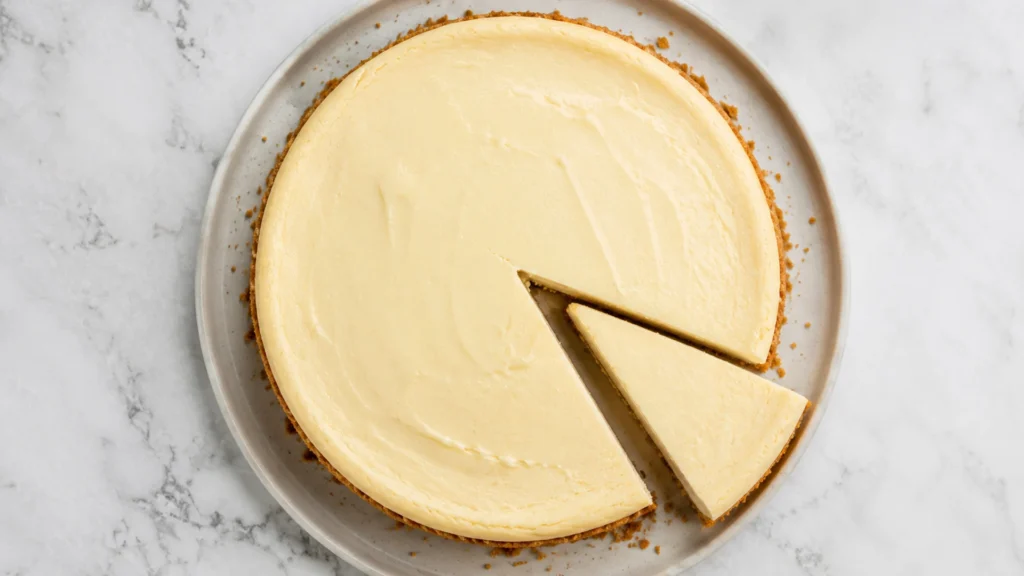
A keto cheesecake is a classic baked cheesecake rebuilt without sugar or wheat: an almond flour crust in place of graham crackers, a cream cheese filling sweetened with erythritol, allulose, or monk fruit instead of sugar, and net carbs that land around 4 to 6 grams a slice instead of 30-plus. The texture is the same dense, tangy, fork-bends-slowly cheesecake you remember. The carbs are not. Done right, nobody at the table can tell it is keto, which is exactly the point of a dessert this rich.
Most keto cheesecake recipes hand you an ingredient list and a bake time and leave you to find out the hard way why your cheesecake cracked down the middle or turned grainy and sandy as it cooled. That is the gap this guide fills. You will get the classic baked recipe with macros, but also the food science of why cheesecakes fail, a real comparison of the three keto sweeteners and what each does to texture, a no-bake version for hot days, and a troubleshooting section for the exact problems that ruin a keto cheesecake. If you want the broader picture of where sweet treats fit on this diet, the keto desserts collection sorts the options by net carbs.
What makes a cheesecake keto
A standard cheesecake is carb-heavy for two reasons, and keto fixes both. The first is the crust. Graham crackers are wheat flour and sugar, which is pure carbohydrate, so a single slice of the crust alone can carry 15 to 20 grams of carbs. Swap in almond flour bound with melted butter and a spoonful of sweetener and the crust drops to about 2 grams net carbs a slice. The second is the filling. Classic cheesecake leans on a cup and a half or more of granulated sugar, which is roughly 300 grams of carbohydrate spread across the cake. Replace that with a sugar-free sweetener that the body does not metabolize as glucose and the filling carbs come almost entirely from the cream cheese and eggs, which are naturally low.
That leaves you with a dessert built on three keto-friendly anchors: cream cheese at about 1 to 2 grams net carbs per ounce, eggs at under 1 gram each, and a zero-net-carb sweetener. Cream cheese is the whole show here, because it is high fat, low carb, and sets into that dense structure when baked with egg. The eggs do the binding and give the cake its lift and its silk. Everything else, the lemon, the vanilla, the pinch of salt, is flavor that costs you nothing. Get those three anchors right and the macros take care of themselves.
The almond flour crust
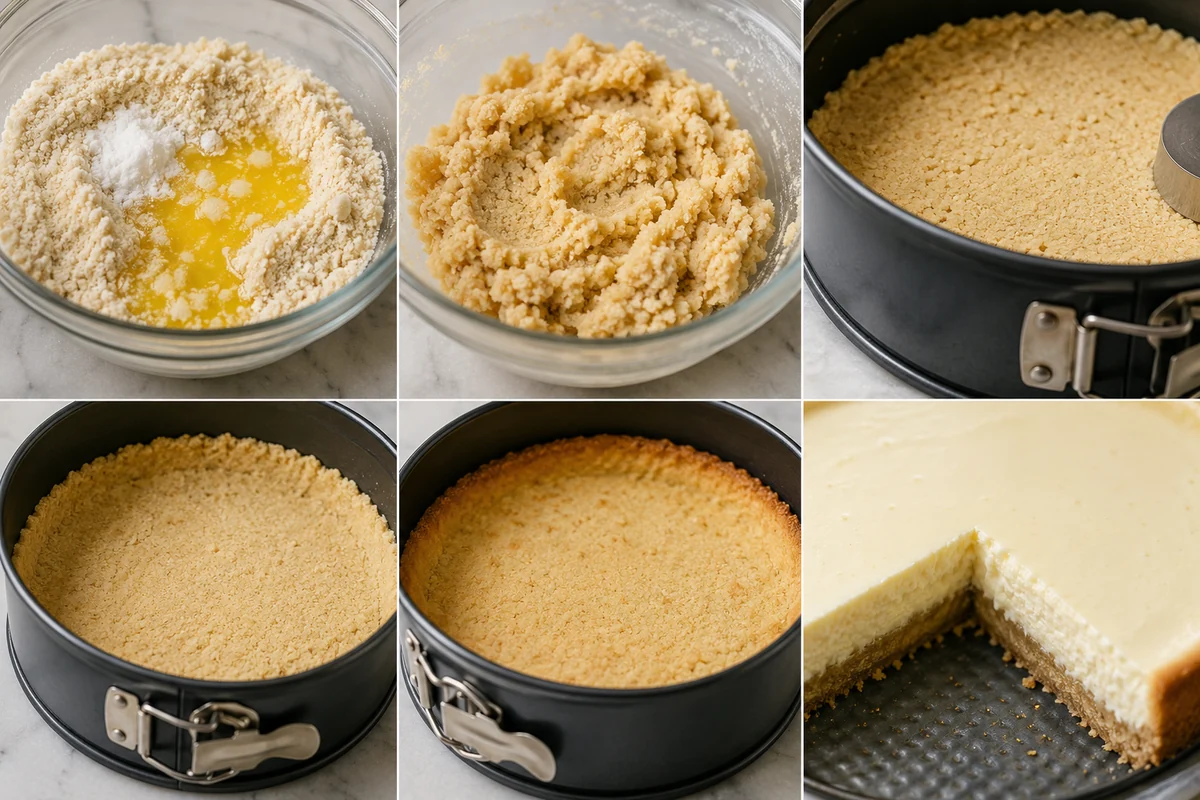
The crust is where keto cheesecakes most often go wrong before the filling ever enters the oven, and the fix is simple once you understand what almond flour does differently from graham crumbs. Almond flour has no gluten and far more fat, so it will not bind into a firm crust by sheer pressure the way a graham crust does. It needs help. The standard ratio is 2 cups of blanched almond flour to one third cup of melted butter and about 3 tablespoons of a granular sweetener, plus a pinch of salt. Use blanched almond flour, not almond meal, because the skins in meal make the crust gritty and dark.
Press the mixture firmly into the bottom of a 9-inch springform pan with the flat base of a measuring cup so it compacts evenly. Then, and this is the step most recipes skip, pre-bake the crust at 350 degrees for about 10 to 12 minutes until it just turns golden at the edges. Pre-baking sets the fat and the structure so the crust does not turn into a soggy pad under the wet filling. Let it cool while you make the filling. If you have built a keto crust before, say for the fathead doughs covered in the keto bread guide, the same principle applies: almond and cheese-based bases need heat to set before they carry weight.
Choosing your sweetener: erythritol vs allulose vs monk fruit
This is the decision that separates a good keto cheesecake from a disappointing one, and almost no recipe explains it. The three common keto sweeteners do not behave the same in a baked, chilled dessert. The difference comes down to one thing: what they do as the cake cools in the fridge. Erythritol, the most common, recrystallizes when cold, which can leave a slight sandy or grainy bite if you use a granular form instead of powdered. Allulose stays dissolved and soft, so it gives the smoothest, most sugar-like texture and even helps the cake brown. Monk fruit is often blended with erythritol, so read the bag, because a pure monk fruit extract is intensely sweet and used in tiny amounts.
| Sweetener | Sweetness vs sugar | Net carbs | Texture effect | Best use |
|---|---|---|---|---|
| Erythritol (powdered) | About 70 percent | 0 g net | Can recrystallize cold; powdered avoids grit | Most baked cheesecakes; use powdered |
| Allulose | About 70 percent | 0 g net | Stays dissolved and soft; browns well | The smoothest filling; no-bake too |
| Monk fruit blend | 1 to 1 with sugar | 0 g net | Acts like the erythritol it is cut with | Easy 1:1 swap; check the blend |
| Pure monk fruit extract | 150 to 200 times | 0 g net | No bulk; tiny amounts only | Boosting sweetness, not bulk |
A sound default for cheesecake is powdered erythritol in the filling for reliability and cost, with a splash of allulose for the absolute smoothest result. The key word is powdered. Granular erythritol in a cold, dense filling is the single most common cause of that gritty texture people blame on keto baking itself. Run granular sweetener through a blender for thirty seconds if powdered is all you can find. For the wider question of how much sweetness you can get away with and which sweeteners stay clean on this diet, the breakdown of how much sugar you can have on keto covers the sugar alcohols in detail. Healthline also has a solid, research-backed rundown of how erythritol and sugar alcohols behave in the body if you want the science behind why these subtract cleanly from your carb count.
The classic baked recipe with macros
Here is the main version. It fills a 9-inch springform and cuts into 12 slices. The crust is the almond flour base above. The filling is 32 ounces, that is four 8-ounce blocks, of full-fat cream cheese at room temperature, 1.25 cups of powdered erythritol, 3 large eggs, 1 tablespoon of lemon juice, 2 teaspoons of vanilla extract, and a quarter teaspoon of salt. Room-temperature cream cheese is not optional. Cold cream cheese will not blend smooth and you will fight lumps all the way to the oven.
Beat the cream cheese alone first until completely smooth, scraping the bowl twice. Add the sweetener and beat in. Then add the eggs one at a time on low speed, mixing only until each just disappears. This low-and-slow egg step is the whole game for a crack-free cake, and the next section explains why. Stir in the lemon, vanilla, and salt by hand. Pour over the cooled crust, smooth the top, and bake at 325 degrees for 50 to 60 minutes. The cake is done when the outer two inches are set but the center 3 inches still jiggles like firm jello when you nudge the pan. It will finish setting as it cools. Here is roughly where the macros land per slice, at 12 slices.
| Per slice (1/12) | Amount |
|---|---|
| Calories | About 340 |
| Fat | About 33 g |
| Protein | About 7 g |
| Total carbs | About 6 g |
| Fiber | About 1.5 g |
| Net carbs | About 4.5 g |
The net-carb math is worth showing because it is where the sweetener choice pays off. The erythritol contributes zero net carbs, so the roughly 4.5 grams a slice come almost entirely from the cream cheese, the eggs, and the small amount of almond flour in the crust split across twelve pieces. If you cut the cake into 16 thinner slices, you drop to about 3.4 grams net carbs each, which suits a dessert that barely touches the day’s budget. That is the advantage of doing the math instead of trusting a single headline number.
Why keto cheesecakes crack and how to stop it
A crack is not a flavor problem, but it looks like failure and it tells you something went wrong with the structure. Three things cause it, and all three are preventable once you know the mechanism. The first is overmixing the eggs. When you beat eggs hard into the batter, you whip air into it. That air expands in the heat of the oven, the cake puffs up like a souffle, and then it collapses as it cools, tearing the surface as it falls. The fix is the low-speed, one-at-a-time egg step from the recipe. You want the eggs incorporated, not aerated.
The second cause is overbaking. Cheesecake is a custard, and custard sets from the edge inward. If you bake until the center is firm, the edges are already overcooked, and overcooked egg protein squeezes out moisture and contracts, which cracks the top. That is why you pull the cake while the center still jiggles. It carries enough residual heat to finish on the counter. The third cause is thermal shock, a fast temperature drop. Yank a hot cheesecake into cold air and the surface contracts faster than the inside, and it splits. The classic professional fix is a water bath, where the springform sits in a pan of hot water that buffers the heat and keeps the cooking gentle and even. America’s Test Kitchen has thorough, tested guidance on running a cheesecake water bath without leaks, which is worth reading if you want a flawless surface every time.
If a water bath feels fussy, there is a simpler version of the same idea. When the bake time is up, turn the oven off, crack the door open with a wooden spoon, and let the cake cool inside the slowly cooling oven for an hour before it goes to the counter. That gentle, gradual cooldown does most of what a water bath does. And here is the honest truth: a crack is purely cosmetic. It does not change the taste or the texture one bit, and a layer of whipped cream or a few berries hides it completely. A cracked cheesecake often goes unnoticed under a topping.
The no-bake version
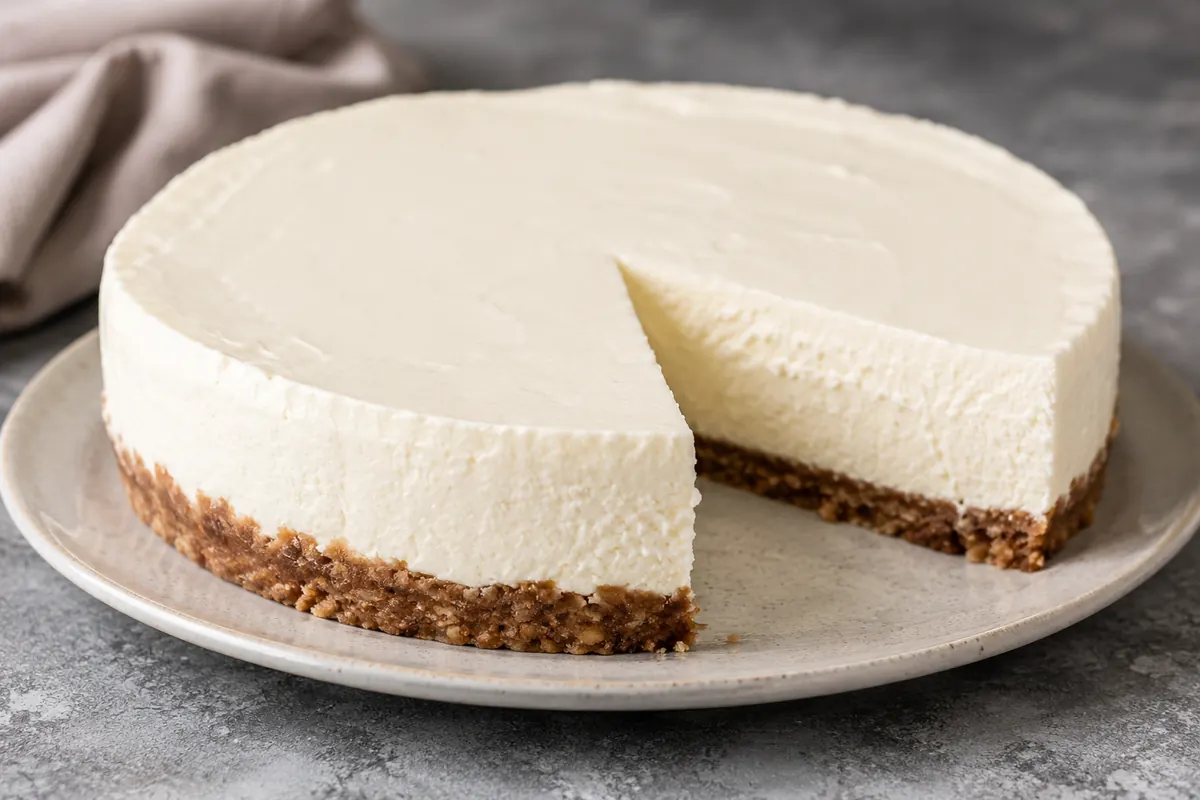
When it is too hot to run the oven, or you simply do not want to babysit a bake, the no-bake keto cheesecake is a genuinely different dessert with its own merits. There are no eggs and no baking, so there is no cracking to worry about and nothing to overcook. The trade-off is texture. A baked cheesecake is dense and firm. A no-bake is lighter, softer, more like a mousse that holds its shape, because it sets from cold and from whipped cream rather than from cooked egg.
To make it, beat 16 ounces of softened cream cheese with three quarters of a cup of powdered sweetener, a tablespoon of lemon, and a teaspoon of vanilla until smooth. Separately whip one cup of heavy cream to stiff peaks, then fold it into the cream cheese mixture gently to keep the air in. Spread it over a pre-baked, fully cooled almond flour crust and refrigerate at least 4 hours, or overnight for a cleaner slice. The net carbs run similar to the baked version, around 4 grams a slice, because the ingredients are nearly the same minus the eggs. This is where allulose earns its keep, because a no-bake never gets the heat that helps dissolve erythritol, so the soft-staying sweetener gives a noticeably smoother set. If a fully different take on the format interests you, the keto tofu cheesecake swaps in silken tofu for an even lighter, higher-protein result.
Flavor variations and toppings
The plain vanilla base is a blank canvas, and most variations cost almost nothing in carbs. For chocolate, melt 3 ounces of sugar-free dark chocolate and beat it into the baked filling, which adds maybe a gram of net carbs a slice. For a swirl, dot the top with a few teaspoons of a sugar-free raspberry or strawberry sauce before baking and drag a knife through it. Pumpkin cheesecake works by adding half a cup of pure pumpkin puree and a teaspoon of pumpkin pie spice, though pumpkin does carry a little carbohydrate, so it nudges you up by about a gram a slice.
Toppings are where you control the final carb count, so choose with intent. A dollop of unsweetened whipped heavy cream is free of net carbs and hides any surface crack. Fresh raspberries and blackberries are the lowest-carb berries, at roughly 2 to 4 grams net carbs per half cup, so a scattering adds almost nothing. A drizzle of sugar-free chocolate or caramel sauce keeps it keto if the sweetener is erythritol or allulose. What to avoid is the obvious: graham crumbs, canned cherry topping, and anything labeled fruit filling, which are sugar in disguise and can double the carbs of a slice in one spoonful. The cake is the work; the topping is where a careless choice undoes it.
Storage and freezing
A baked keto cheesecake keeps better than most desserts, which makes it a smart make-ahead. In the fridge, covered, it holds for 5 to 7 days, and many people think it tastes better on day two once the flavors settle and the texture firms. Keep it covered tightly, because cream cheese readily picks up other smells from the fridge. A no-bake version is a little more delicate and is best eaten within 4 days.
It also freezes well, which is the part most recipes leave out. To freeze the whole cake, chill it fully first, then wrap it in plastic and then foil and freeze for up to 3 months. To freeze by the slice, cut the chilled cake, set the slices on a tray to firm up for an hour, then wrap each one individually so you can pull a single serving at a time. Thaw in the fridge overnight, never on the counter, because a fast thaw weeps moisture onto the surface. One honest note on the sweetener: erythritol can recrystallize slightly through a freeze-thaw cycle, so a frozen-then-thawed slice may read a touch grainier than fresh. Allulose handles freezing better if that bothers you. Either way, the cake is still good, and having keto dessert in the freezer is the kind of insurance that keeps you out of the real sugar when a craving hits.
Frequently Asked Questions
How many net carbs are in a slice of keto cheesecake?
About 4 to 6 grams of net carbs per slice when the cake is cut into 12, using an almond flour crust and a zero-carb sweetener like erythritol or allulose. Cut it into 16 thinner slices and you drop to roughly 3.4 grams each. The carbs come from the cream cheese, eggs, and almond flour, not the sweetener, since erythritol and allulose contribute zero net carbs.
Which sweetener is best for keto cheesecake?
Powdered erythritol is the reliable default, and allulose gives the smoothest texture because it stays dissolved instead of recrystallizing when cold. Use powdered, not granular, to avoid a sandy bite in the chilled filling. Monk fruit usually comes blended with erythritol, so it behaves like the blend; check the bag before swapping it one for one with sugar.
Why did my keto cheesecake crack?
Cracks come from three things: overmixing the eggs and whipping in air, overbaking until the center is firm, or cooling the cake too fast. Mix eggs in on low speed one at a time, pull the cake while the center still jiggles, and cool it slowly in the turned-off oven with the door cracked. A crack is only cosmetic, though, and a topping hides it completely.
Can I make keto cheesecake without baking it?
Yes. A no-bake keto cheesecake skips the eggs and sets in the fridge using whipped heavy cream folded into sweetened cream cheese over a pre-baked almond flour crust. It is lighter and softer than a baked cheesecake, more like a firm mousse, with similar net carbs around 4 grams a slice. Chill it at least 4 hours, ideally overnight, for clean slices.
Why is my keto cheesecake grainy?
Graininess almost always comes from granular erythritol, which recrystallizes in a cold, dense filling and leaves a sandy texture. Use powdered erythritol, or blend granular into a powder before mixing. A second cause is cold cream cheese that never fully smoothed out, so always start with room-temperature cream cheese and beat it alone until silky before adding anything else.
How long does keto cheesecake last?
A baked keto cheesecake keeps 5 to 7 days in the fridge, tightly covered so it does not absorb other smells, and many people find it tastes better on day two. It freezes for up to 3 months, whole or sliced; wrap slices individually and thaw them in the fridge overnight. A no-bake version is more delicate and is best eaten within about 4 days.
Bottom line
A keto cheesecake delivers the full dense, tangy experience of the real thing for about 4 to 6 grams of net carbs a slice, and the recipe is forgiving once you understand the few places it goes wrong. Build the crust from blanched almond flour and pre-bake it. Sweeten with powdered erythritol or allulose, never granular, to dodge the grainy texture. Mix the eggs on low and pull the cake while the center jiggles to keep it crack-free, then cool it slowly. Show yourself the per-slice math so you can size portions to your day. Whether you bake it or set it cold in the fridge, this is the dessert that proves keto does not mean going without. Make it once and it becomes the thing you bring to every gathering.