

Is keto good for diabetes? For many people with type 2 diabetes or prediabetes, yes, cutting carbs to a ketogenic level lowers blood sugar fast and often cuts the need for medication. But “good” depends entirely on which kind of diabetes you have, what drugs you take, and whether you can keep it up. The honest answer is not a clean yes or no.
Here is the direct version, the kind you want at 6 a.m. before your coffee. If you have type 2 diabetes or prediabetes and you are not on insulin or sulfonylureas, a well-built keto diet usually drops your A1C and your weight within weeks. If you are on those medications, keto can work even better, but you have to adjust the doses with your doctor first or you risk a dangerous low. If you have type 1 diabetes, keto is possible but it is advanced-mode and needs close monitoring. That is the whole thing in four sentences. The rest of this is how to do it without hurting yourself.
What keto actually does to blood sugar
Carbohydrate is the macronutrient that raises blood glucose the most. Protein nudges it a little. Fat barely moves it. So when you drop carbs to roughly 20 to 30 grams of net carbs a day, the single biggest driver of post-meal glucose spikes mostly disappears. Your fasting glucose falls. Your A1C, which is the three-month average, follows a few weeks later.
That is not a theory. In a Stanford crossover trial, participants with type 2 diabetes or prediabetes saw HbA1c drop about 9 percent on keto versus about 7 percent on a Mediterranean diet over 12 weeks. Both worked. Keto edged ahead on glucose and triglycerides. The catch, covered further down, is what happened after the study ended.
There is a second mechanism people forget: insulin. High insulin levels are part of the problem in type 2 diabetes, not just high glucose. When you stop spiking glucose, your pancreas stops dumping insulin to chase it. Fasting insulin drops. For someone with insulin resistance, that is the lever that actually matters, and it is why some people reverse their type 2 markers entirely, not just paper over them.
Type 2 diabetes and prediabetes: where keto shines

This is the group keto helps most clearly. If your beta cells still make insulin and the core issue is resistance plus too many carbs, removing the carbs hits the problem at the source. People in this group often watch their morning readings fall 20 to 40 mg/dL within the first week, sometimes more.
Prediabetes is the easiest case of all. You usually are not on glucose-lowering drugs, so there is no hypoglycemia risk from the diet itself, and a few months of keto can pull a fasting glucose back out of the prediabetic range. If one group gets the cleanest win with the least danger, it is people with prediabetes who are not on any medication.
A practical day under 30 grams net carbs looks like this: eggs scrambled in butter with spinach and avocado for breakfast (about 4 net carbs), a chicken-and-cheese lettuce wrap lunch (about 5 net carbs), and salmon with roasted broccoli and olive oil for dinner (about 7 net carbs). That is roughly 16 net carbs, leaving room for a handful of macadamias. Protein lands around 110 to 130 grams, fat around 130 grams, which is a sane 60 to 70 percent of calories from fat. If you want plug-and-play versions, these keto lunch ideas built to stay under 6 net carbs map cleanly onto a diabetes-friendly day.
The medication trap nobody warns you about loudly enough
Here is the part the big sites mention in one line and move past. If you take insulin or a sulfonylurea (glipizide, glyburide, glimepiride), these drugs lower your blood sugar whether or not you ate carbs. Cut the carbs and keep the same dose, and you can crash into hypoglycemia, which feels like shakiness, sweating, confusion, and at the extreme is an emergency. A blood glucose under 70 mg/dL is the standard low threshold; under 54 mg/dL is serious.
The fix is simple and non-negotiable: talk to your prescriber before you start, not after your first low. Many doctors will pre-emptively cut a sulfonylurea or mealtime insulin when a patient goes keto, precisely because the carb drop does so much of the work. Do not adjust insulin yourself by guessing, but do not start keto on a full sulfonylurea dose and hope, either.
There is one more landmine. If you take an SGLT2 inhibitor (empagliflozin, dapagliflozin, canagliflozin, the “-flozin” drugs) and you also go very low carb, you can develop euglycemic diabetic ketoacidosis, meaning DKA while your glucose still reads normal. It is rare but real, and it is the one combination to clear with a doctor every single time. Normal glucose does not mean you are safe on that pairing.
Type 1 diabetes: possible, but advanced-mode
Type 1 is a different animal. You make no insulin, so you inject all of it, and keto changes both your basal and bolus needs. Plenty of people with type 1 run keto successfully and love the flatter glucose lines it gives them. But the margin for error is thinner. You have to monitor both glucose and blood ketones, because in type 1 the line between nutritional ketosis (a fine 0.5 to 3.0 mmol/L) and ketoacidosis (dangerous, usually with high glucose and illness) can blur if your insulin runs short.
My honest take: if you have type 1, do not go keto solo off a blog post. Do it with an endocrinologist or a diabetes educator who has done it before, ideally with a continuous glucose monitor and a blood ketone meter on hand. The diet can be genuinely good for type 1 glucose stability. The setup just has to be done right. The NIDDK overview of diabetes management is a level-headed place to understand how diet, insulin, and monitoring fit together before you change anything.
The fiber problem, and how to not wreck your gut
Every honest review of keto for diabetes flags the same weakness: it tends to be low in fiber and a few micronutrients. The Stanford data showed keto running lower in fiber and in vitamins B6, C, D, and E. Low fiber means constipation and, over time, a less happy gut microbiome. This is fixable, and most people simply do not bother, which is why they feel rough.
Build fiber back in on purpose. Non-starchy vegetables are the workhorses: broccoli, cauliflower, asparagus, zucchini, leafy greens, all low in net carbs and high in fiber. Add chia and ground flax (chia is about 10 grams fiber per ounce against almost no net carbs once you subtract fiber). Avocado gives you fiber and potassium together. Aim for 25 grams or more of fiber a day even in ketosis; it is very doable. The American Diabetes Association’s guidance on carbohydrates and fiber is a solid baseline to check your numbers against.
Electrolytes: the missing piece that makes or breaks keto for diabetics
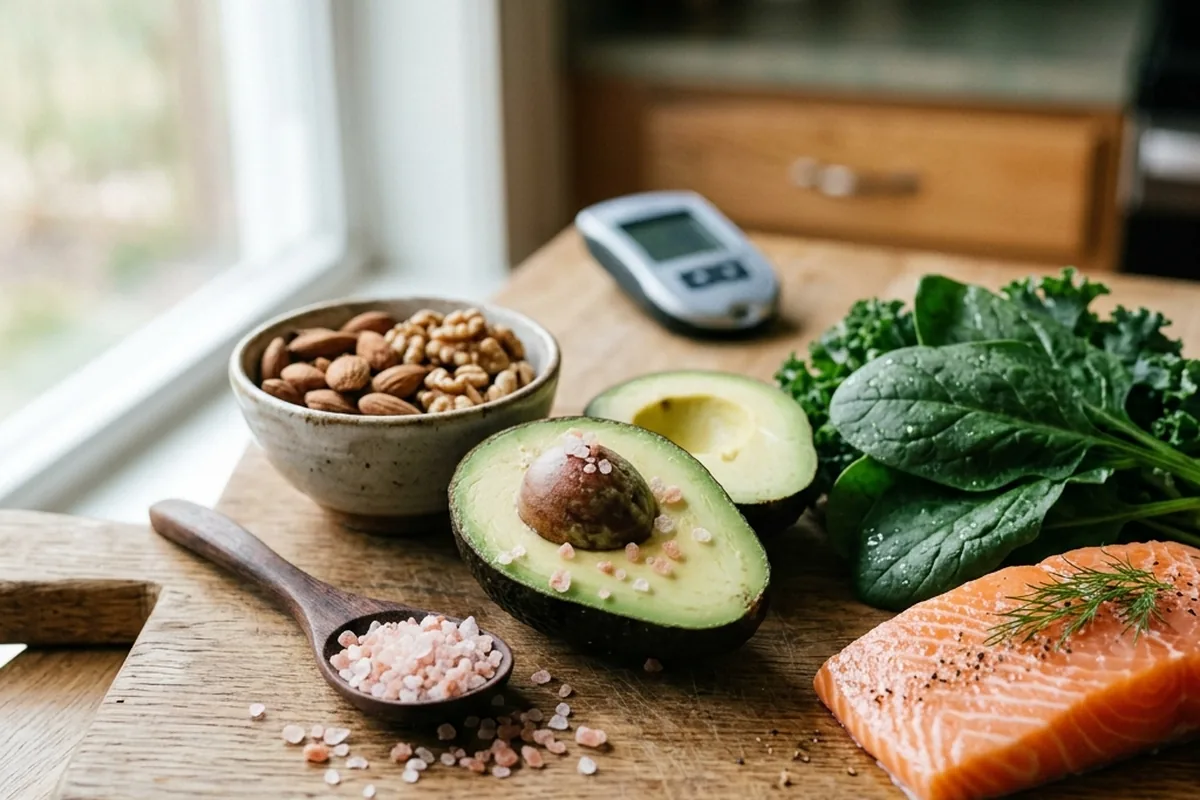
When you cut carbs hard, your body sheds water and sodium fast in the first two weeks. That is the famous “keto flu,” and for someone with diabetes it matters more than for the average dieter, because dehydration and low electrolytes can muddy your glucose readings and make you feel awful enough to quit. People blame keto for fatigue and headaches when the real culprit is plain salt and potassium running low.
Here is a rough daily target: about 4,000 to 5,000 mg of sodium, 3,000 to 4,000 mg of potassium, and 300 to 400 mg of magnesium. That sodium number looks high if you grew up being told salt is the enemy, but on keto your kidneys dump it, and most people are not over-salted, they are under-salted. Salt your food, sip broth, and the headaches usually vanish in a day. Potassium comes from avocado, spinach, and salmon; magnesium from pumpkin seeds, almonds, and a supplement if you fall short. Diabetics on certain blood-pressure or diuretic medications should run these targets past a doctor, since some drugs already shift potassium.
A typical case: a beginner ready to give up in week one, convinced keto was wrecking his energy. His glucose was fine. His sodium was the problem. Two cups of salted bone broth a day, and he was a different person by the weekend. Electrolytes are boring and they are the single most common reason people fail keto in the first month.
Building diabetes-friendly keto meals you will actually eat
The diets that lower A1C are the ones people keep eating, so the cooking has to be good, not just compliant. Non-starchy vegetables are your fiber, your volume, and your micronutrients, and the difference between sad steamed broccoli and broccoli roasted at 425 degrees F until the edges char is the difference between a diet you tolerate and one you look forward to. America’s Test Kitchen has a deep archive of vegetable cooking techniques that translate straight to keto, since most are built on fat, salt, and high heat rather than breading or sugar.
A few rules that keep diabetic keto meals both in range and worth eating. Anchor every plate with a real protein portion, 4 to 6 ounces, so you are satisfied and not snacking into a glucose creep later. Cook vegetables in fat, not water, because fat carries flavor and slows digestion, which flattens the glucose curve. Keep a fat-and-acid sauce on hand (a quick garlic aioli, a lemon-butter, a vinaigrette) so the same chicken breast does not bore you by Wednesday. And batch-cook on Sunday; the number one predictor of who stays in range is who has food ready when they are tired and hungry. If you want a structured starting point, the breakfast end of the day is where most diabetics slip, so lean on fast, filling options that stay low.
Keto versus other diabetes diets: the head-to-head
Keto is not the only carb-aware approach, and pretending it is the best for everyone would be dishonest. The Mediterranean diet, in that same Stanford trial, gave nearly the same A1C drop (7 versus 9 percent), more fiber, lower LDL, and far better adherence. Three months after the study, even the strict keto group had mostly drifted to Mediterranean eating.
| Approach | Typical carbs/day | A1C effect | Adherence |
|---|---|---|---|
| Ketogenic | 20-30 g net | Strong, fast | Hard long-term |
| Low carb (not keto) | 50-100 g | Good | Easier |
| Mediterranean | 130-180 g | Good | Easiest |
So why keto at all? Because for the right person, fast results build belief, and belief keeps you going. If watching your morning glucose drop 30 points in a week is what makes you stick to a plan, keto’s speed is a feature. The smart move many people make is to use strict keto for three to six months to break insulin resistance and lose weight, then loosen to a sustainable low-carb or Mediterranean-leaning pattern they can hold for life. The diet that works is the one you actually keep doing.
Should you try keto for your diabetes? A quick decision path
Run yourself through this honestly before you start.
- Prediabetes, no meds: Green light. Start keto, retest fasting glucose and A1C in 8 to 12 weeks. Lowest risk, clean upside.
- Type 2, on metformin only: Generally safe to start. Metformin alone rarely causes lows. Tell your doctor anyway and recheck labs.
- Type 2, on insulin or a sulfonylurea: Talk to your prescriber FIRST about lowering the dose. Then start. Have fast-acting glucose on hand for lows.
- On an SGLT2 inhibitor (-flozin): Clear it with your doctor specifically because of euglycemic DKA risk. Do not freelance this one.
- Type 1 diabetes: Only with an endocrinologist, a CGM, and a blood ketone meter. Do not start solo.
Whichever lane you are in, get a baseline A1C and fasting glucose before day one, then retest at 8 to 12 weeks so you have real numbers, not vibes. For the food framework that keeps you in range, the keto diet guidelines on macros and carb limits spell out exactly where to set your targets, and the broader overview of how keto works and how to stay in ketosis covers the mechanics if this is all new.
FAQ
Can keto reverse type 2 diabetes?
It can drive type 2 diabetes into remission for some people, meaning normal A1C without medication, especially early in the disease and paired with weight loss. Remission is not the same as a cure; carbs raise glucose again if you go back to them. Keep monitoring even when your numbers look great.
Is keto safe if I take insulin?
It can be, but not at your current dose. Cutting carbs while keeping full insulin doses risks hypoglycemia. Work with your prescriber to lower doses before or as you start, keep fast-acting carbs nearby for lows, and test glucose more often the first two weeks.
What is the carb limit for keto with diabetes?
Most people reach and hold ketosis at 20 to 30 grams of net carbs per day (total carbs minus fiber). Some stay in ketosis a bit higher; others need to go lower. Test with ketone strips or a blood ketone meter to find your personal threshold.
Does keto raise cholesterol in diabetics?
It varies. Triglycerides usually fall and HDL rises, both good. LDL goes up in a minority of people, as it did on average in the Stanford trial. If you have heart risk, get a lipid panel before and after, and discuss the pattern with your doctor rather than assuming it is fine or fatal.
Can keto cause ketoacidosis in diabetics?
Nutritional ketosis (0.5 to 3.0 mmol/L) is not ketoacidosis. The real risk is in type 1 diabetes when insulin runs short, and in anyone on an SGLT2 inhibitor, where euglycemic DKA can occur with normal glucose. Those two situations need medical oversight; for most people on type 2 with intact insulin production, dietary ketosis is safe.
How fast will keto lower my blood sugar?
Fasting glucose often drops within the first week, sometimes 20 to 40 mg/dL for people with type 2. A1C reflects a three-month average, so expect a meaningful change at the 8 to 12 week retest, not on day three.
Bottom line
Is keto good for diabetes? For type 2 and prediabetes, it is one of the most effective dietary tools we have for lowering blood sugar and insulin, often quickly. The honest caveats are real: medications need adjusting before you start, fiber and electrolytes need attention, and long-term most people do better easing into a sustainable low-carb pattern than white-knuckling strict keto forever. Get your baseline labs, clear your meds with your doctor, and judge it on your own numbers at twelve weeks. That is how you find out whether it is good for your diabetes, not someone else’s.