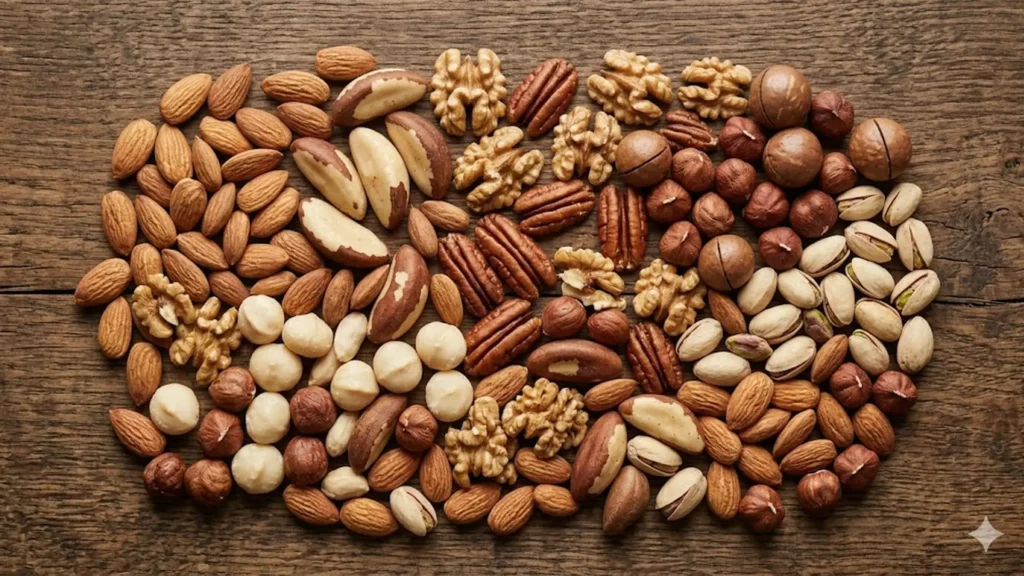
Keto friendly nuts are the low-carb, high-fat nuts you can eat in a measured portion without spending much of your carb budget: macadamias, pecans, Brazil nuts, walnuts, hazelnuts, and almonds all land around 1 to 3 grams of net carbs per ounce. Macadamias and pecans are the lowest at roughly 1.5 grams an ounce. The catch is never which nut, it is how many, because a careless handful can quietly double the carbs and the calories.
Most nut lists rank by net carbs and stop, which leaves out the two things that actually trip people up: a real serving size you can eyeball, and the calorie load that makes nuts a stall risk even when the carbs behave. So this guide gives net carbs at a defined one-ounce serving with the nut count to match, shows how that portion fits your day, and names the prep trick that lets a smaller handful satisfy. If you want the bigger picture of low-carb snacking, the keto friendly snacks guide covers the rest.
The keto friendly nuts ranking, per real serving
Here is the part the lists skip: a one-ounce serving with the count of nuts that gets you there, so you can portion without a scale. Net carbs are per ounce, rounded.
| Nut | Net carbs (1 oz) | Roughly per ounce |
|---|---|---|
| Macadamias | 1.5 g | 10 to 12 nuts |
| Pecans | 1.5 g | 19 halves |
| Brazil nuts | 1.5 g | 6 to 7 nuts |
| Walnuts | 2 g | 14 halves |
| Hazelnuts | 2 g | 21 nuts |
| Almonds | 2.5 g | 23 nuts |
| Peanuts | 2.5 g | 28 nuts |
| Pine nuts | 3 g | 1/4 cup |
| Pistachios | 5 g | 49 nuts |
| Cashews | 8 g | 18 nuts |
Macadamias make a good everyday default, and not only for the low carb count. They are the highest in fat of any common nut, which means six or seven of them genuinely blunt hunger, so the small portion feels like enough. Pecans tie them on carbs and toast beautifully. Brazil nuts are low-carb too, but cap them at two or three a day for a different reason: they are extremely high in selenium, and a half-dozen daily is more than you want long term.
How many nuts fit a keto day
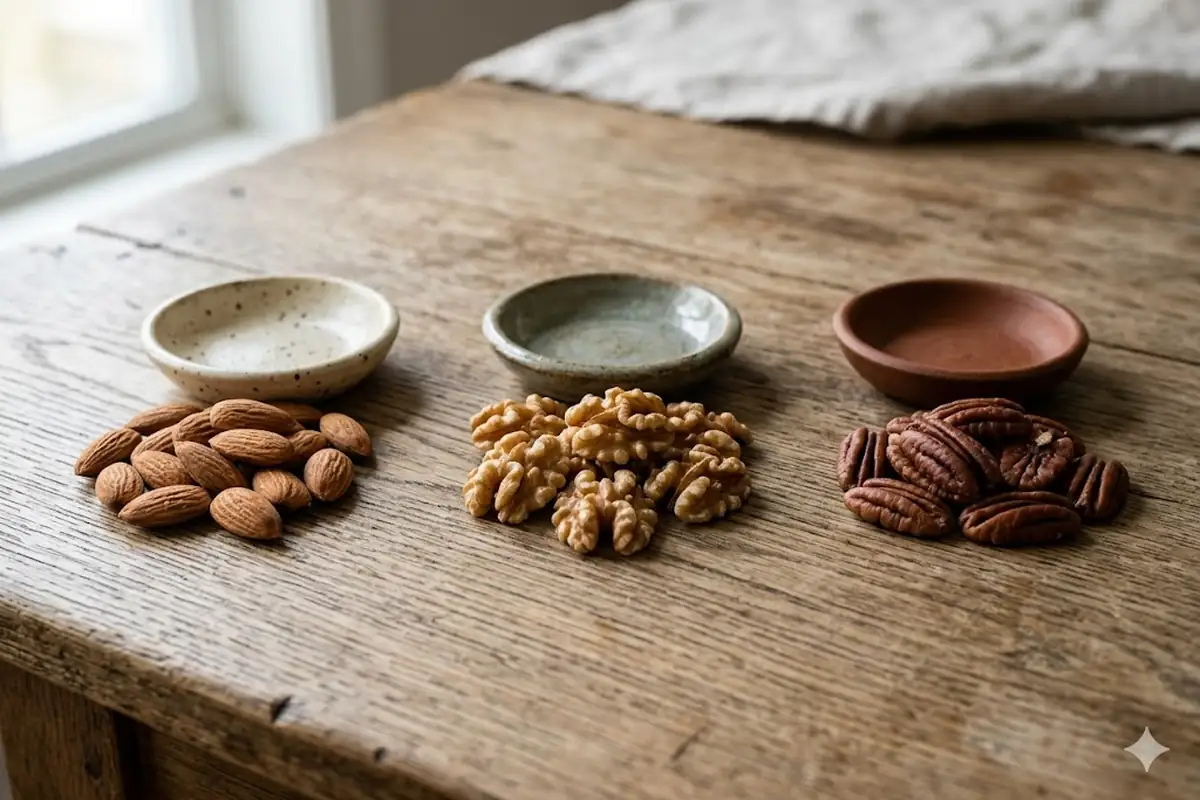
The honest answer most lists dodge: one ounce, once or maybe twice a day, counted into your total. On a strict 20-gram day, an ounce of macadamias spends 1.5 grams, under 8 percent of your budget. Easy. The problem is that nobody eats one ounce of nuts from an open bag. You eat three, and now it is 4.5 grams of carbs and, more quietly, 500 calories.
That calorie number is the part the carb-only rankings ignore, and it is why nuts stall more keto dieters than almost any other food. An ounce of nuts runs 160 to 200 calories. The carbs may stay low through a big handful, but the calories do not, and on keto for weight loss the calories still count. So the working rule is simple: one measured ounce, treated as a portion and not a bottomless snack. Weigh it once to see what an ounce actually looks like in your hand, and you will be surprised how small it is. For where nuts sit among all your options, the keto food list sorts the categories by carbs.
Seeds belong on the keto nut list too
Seeds get left off most “nuts” lists, which is a mistake, because several are as low in carbs as the best nuts and bring things nuts do not. Pumpkin seeds run about 2.7 grams net carbs an ounce and are high in magnesium, a mineral keto dieters often run short on. Sunflower seeds land near 3.5 grams an ounce and make a cheap, satisfying snack. Chia and flax seeds are the standouts at about 2 grams net carbs a serving, and both are mostly fiber, which is why the net number stays so low despite a higher total carb count on the label.
Chia and flax do double duty as binders in keto baking. A tablespoon of ground flax or chia mixed with water forms a gel that replaces egg in some recipes and thickens smoothies and puddings. Hemp seeds, at under 1 gram net carbs a serving, are the lowest of all and add a soft, nutty texture to salads and yogurt. Treat seeds the way you treat nuts: a measured portion, counted into the day. They are a smart way to vary the routine when you are tired of the same handful of macadamias.
The pre-portioned bag system that fixes over-pouring
It is easy to believe you are eating “a handful” of almonds and still not understand why the scale will not move. Weighing the handful settles it. It was nearly three ounces, around 600 calories and 7 grams of carbs, twice a day, which was sabotaging the whole thing. The fix was embarrassingly low-tech and it worked immediately.
The day a new bag comes home, portion the whole thing into small snack bags at one ounce each, using a scale the first few times until your eye calibrates. One bag is one snack, full stop. When the bag is empty, you are done, and there is no second dip into an open container because there is no open container. That single habit matters more than any nut swap, because it solves the real problem, which was never the nut, it was the volume. Keep the bags in a drawer at eye level so the right portion is also the easy grab.
Toasting: how to make a smaller portion satisfy
Here is a technique the lists never mention. Dry-toasting nuts deepens their flavor dramatically, which means a smaller measured portion delivers more taste and you feel satisfied sooner. Spread raw nuts in a dry skillet over medium heat, or on a sheet pan at 350 degrees, and toast for 5 to 8 minutes, shaking often, until they smell fragrant and turn a shade darker. Watch them closely past the five-minute mark because they go from toasted to burnt fast.
Toasting changes nothing about the carbs and adds nothing but a little time, yet a toasted pecan tastes twice as rich as a raw one. Toasting a batch of mixed pecans and macadamias on Sunday, then portioning them, brings a flavor payoff that means you reach for fewer. A pinch of salt or a dusting of cinnamon and a sprinkle of erythritol while they are warm makes a treat that scratches the dessert itch for almost no carbs. Cooking sources like America’s Test Kitchen dig into why heat coaxes more flavor out of the oils, which is the science behind why a toasted nut tastes richer.
The cashew and pistachio trap
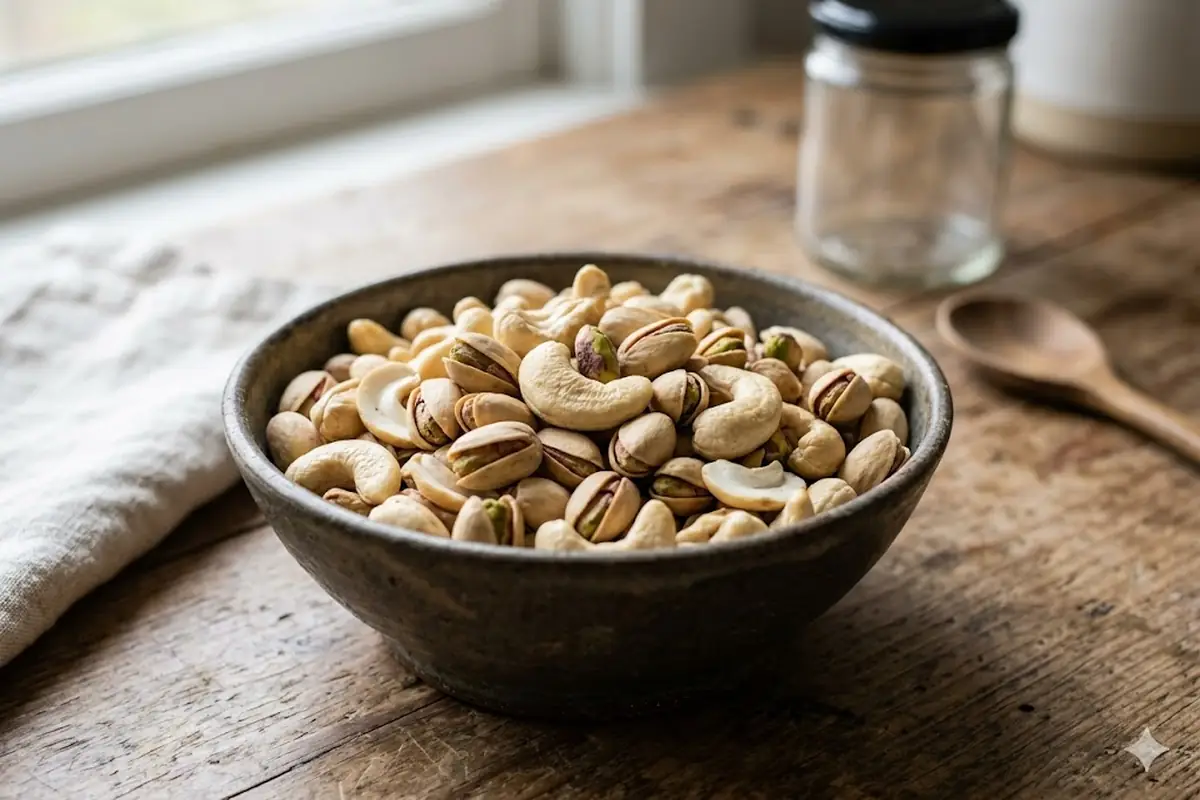
Two popular nuts deserve a warning because they masquerade as keto. Cashews carry 8 grams net carbs an ounce, more than five times a macadamia, so a single generous handful can eat half a strict day. They are also soft and moreish in a way that makes one handful turn into four, which is the worst combination for a high-carb nut. Treat cashews as off the keto list, not a sometimes food.
Pistachios are the sneaky one at 5 grams an ounce, which sounds fine until you remember nobody eats one ounce of pistachios. The shelling slows you down but the snacking goes on for an hour, and a typical sitting is easily three ounces and 15 grams of carbs. If you love them, weigh out one ounce, shell and all, into a bowl and stop there. Chestnuts are simply too high to bother with at over 13 grams an ounce, more starch than nut. The pattern across all three: the higher-carb nuts are also the ones easiest to overeat, so they fail you twice.
There is a deeper reason this matters for keto specifically. The nuts highest in carbs tend to be higher in starch and lower in fat, which means they neither keep you in ketosis nor keep you full the way a fatty macadamia does. So you eat more of them chasing satisfaction that never arrives, piling on both carbs and calories. The low-carb, high-fat nuts work in the opposite direction: the fat satisfies fast, so the small portion is genuinely enough. That is the whole logic of choosing nuts on keto, and it is why the ranking is not arbitrary. Fat satisfies, starch does not, and the carb count tends to track which is which. Once you internalize that single idea, picking the right nut at the store becomes automatic and you stop second-guessing the bag in your hand.
What each top nut actually brings
Beyond carbs, the nuts differ in ways worth knowing when you pick a default. Macadamias are the fat king, mostly monounsaturated fat, the same kind found in olive oil, which is part of why they sit well on keto and keep you full. Pecans are rich in antioxidants and toast to a buttery depth that makes them a strong pick for any baked application. Walnuts are the omega-3 standout, the only common nut with a meaningful amount of the plant form of those fats, so they earn a regular spot for that alone.
Brazil nuts are a selenium powerhouse, which is a benefit and a caution at once: one or two a day covers your selenium, but six or more daily over time is too much of it, so these are the one nut to ration deliberately low. Almonds are the versatile workhorse, good raw, good roasted, and the source of the almond flour that makes keto bread and cookies possible. Hazelnuts bring a distinct sweet aroma that pairs with chocolate for a keto dessert. Knowing these differences lets you rotate nuts for variety and nutrition instead of eating the same one out of habit, which keeps the routine sustainable.
Putting keto nuts to work beyond snacking
Nuts earn their place in cooking, not just the snack drawer. Almond flour, which is just ground blanched almonds, is the backbone of keto baking, standing in for wheat flour at about 3 grams net carbs a quarter cup. Pecans and walnuts make a low-carb crust for cheesecake or a crunchy topping for roasted vegetables. Macadamias blended with a little oil become a creamy dairy-free sauce base. A handful of toasted walnuts turns a plain green salad into a meal, and nut butters, as long as they are the no-sugar-added kind, are an easy fat boost stirred into coffee or smeared on celery.
The one rule that carries through all of it is portion awareness, because even in cooking the carbs and calories add up. Saucegrove has a guide to asian sauces that shows how a small amount of nut can build a big-flavor sauce, which is the efficient way to use them. For building whole low-carb plates around these ingredients, the keto meals formula ties it together. Food publications like Bon Appetit are a good place to browse for ideas on cooking with nuts for texture.
Buying and storing so they stay fresh
Nuts are high in fat, which means they go rancid faster than most pantry foods, and rancid nuts taste flat and slightly bitter. Buy raw nuts if you plan to toast your own, since pre-roasted ones are often cooked in seed oils and salted heavily. Check for “no sugar added” on anything flavored, because honey-roasted, candied, and many “trail” mixes carry added sugar that wrecks the carb count. Whole nuts keep longer than chopped or ground, so buy almond flour in amounts you will use within a couple months.
Store nuts in an airtight container in a cool, dark spot, and for anything you are not eating within a few weeks, the fridge or freezer doubles their life. Keep working portion bags in a drawer and the bulk bag in the freezer, pulling from it to refill. Frozen nuts thaw in minutes and lose nothing. This matters more than it sounds, because a bag of stale, oily nuts is the fastest way to stop reaching for your healthiest keto snack and drift toward something worse.
A note on the numbers in this guide: each net-carb figure comes from USDA FoodData Central for the raw nut, with fiber subtracted from total carbs, then scaled to a one-ounce serving and cross-checked against the nut count that weighs an ounce. After years of building keto snacks and untangling why people stall, the lesson is always the same with nuts. The carbs were rarely the issue. The portion was. Pin the portion and keto friendly nuts become one of the easiest, most satisfying foods on the whole plan.
Frequently asked questions
What are the best keto nuts?
Macadamias, pecans, and Brazil nuts are the best, all around 1.5 grams net carbs per ounce and very high in fat. Macadamias top the list because their high fat content makes a small portion genuinely filling. Walnuts, hazelnuts, and almonds follow closely at 2 to 2.5 grams an ounce and work well for both snacking and cooking.
How many nuts can I eat on keto?
Stick to one ounce, once or twice a day, counted into your carb total. An ounce of low-carb nuts spends only 1.5 to 2.5 grams of carbs, but it also carries 160 to 200 calories, which is the real limit on keto for weight loss. Pre-portion them so a single serving does not turn into three.
Why are cashews bad on keto?
Cashews carry 8 grams net carbs per ounce, more than five times a macadamia, so a handful can eat half a strict keto day. They are also soft and easy to overeat, which makes the carb problem worse. Most people on a strict day are better off treating cashews as off the list rather than rationing them.
Are peanuts keto?
Yes, peanuts are keto-friendly at about 2.5 grams net carbs per ounce, even though they are technically a legume rather than a true nut. They work for snacking and as no-sugar-added peanut butter. Just check the label on peanut butter, since many brands add sugar that pushes the carbs up.
Do nuts kick you out of ketosis?
Low-carb nuts in a one-ounce portion will not kick you out of ketosis, but overeating them can. The bigger risk is calories stalling weight loss rather than carbs breaking ketosis, since an open bag is easy to finish. High-carb nuts like cashews and pistachios can disrupt ketosis if you eat several ounces.
Does roasting nuts change the carbs?
No, dry-roasting or toasting nuts does not change their carb count. It deepens the flavor by activating the natural oils, which is useful because a more flavorful nut satisfies in a smaller portion. Avoid honey-roasted or candied nuts, which add sugar and can double the carbs.
Which nut is highest in fat?
Macadamia nuts are the highest in fat of the common nuts, which is exactly why they are a keto favorite. The high fat content blunts hunger, so six or seven nuts feel satisfying. That fat density also means they are calorie-dense, so the one-ounce portion rule still applies.