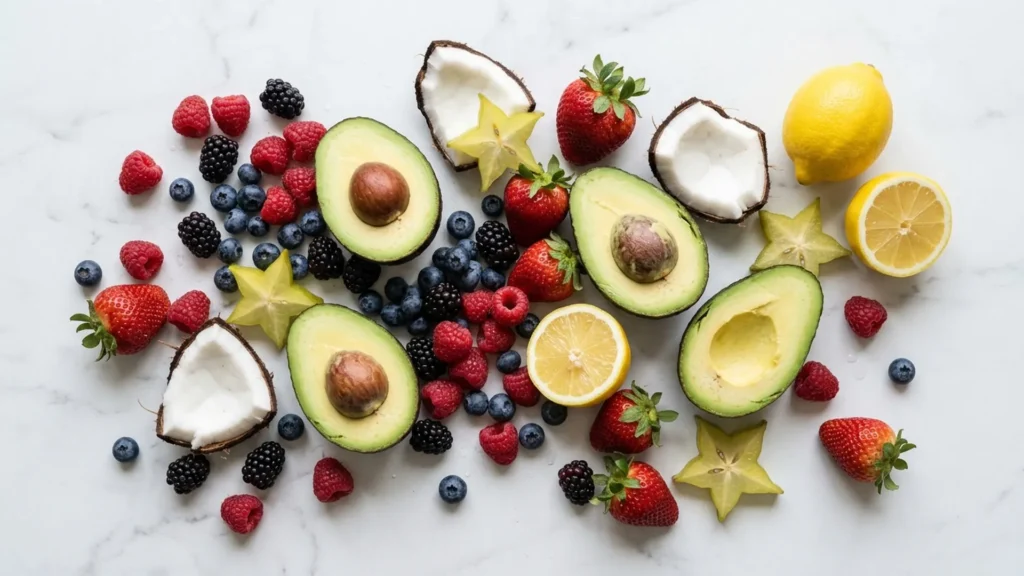
Keto friendly fruits are the short list of low-sugar fruits you can eat without blowing a strict carb budget: berries, avocado, olives, lemon and lime, and small amounts of melon. Most of them land under 9 grams of net carbs per realistic serving, which means a half cup of raspberries fits where a banana never could. The trick is not which fruit, but how much of it, measured against the carbs you have left for the day.
Fruit is where people counting net carbs quietly go wrong. Not because they pick the wrong fruit. Because they pour a “handful” of blueberries that turns out to be three quarters of a cup. So this guide does two things the usual lists skip. It gives you the net carbs at a serving size you actually scoop, and it shows you how that serving spends your daily budget. If you are still setting that budget, the keto diet guidelines walk through where 20 grams comes from.
What makes a fruit keto friendly in the first place
Fruit is sugar wrapped in fiber. The fiber is the saving grace, because your body does not absorb it as carbohydrate, so you subtract it. Total carbs minus fiber equals net carbs, and net carbs are what you track on keto. A fruit earns a spot on the friendly list when its net carbs stay low at a portion a normal person eats in one sitting.
That last clause matters more than the fruit itself. Watermelon clocks about 11 grams net carbs per cup. On paper that reads borderline. In real life nobody eats one cup of watermelon, they eat three, and now you are at 33 grams and out of ketosis before lunch. So the honest question is never “is this fruit keto.” It is “how much of this fruit, and what does that cost today.” Avocado, which is botanically a fruit, sits at the friendly end at roughly 4 grams net carbs for a whole medium one. Olives are even lower, around 1 gram per 10 olives.
The keto friendly fruits list, at servings you actually eat
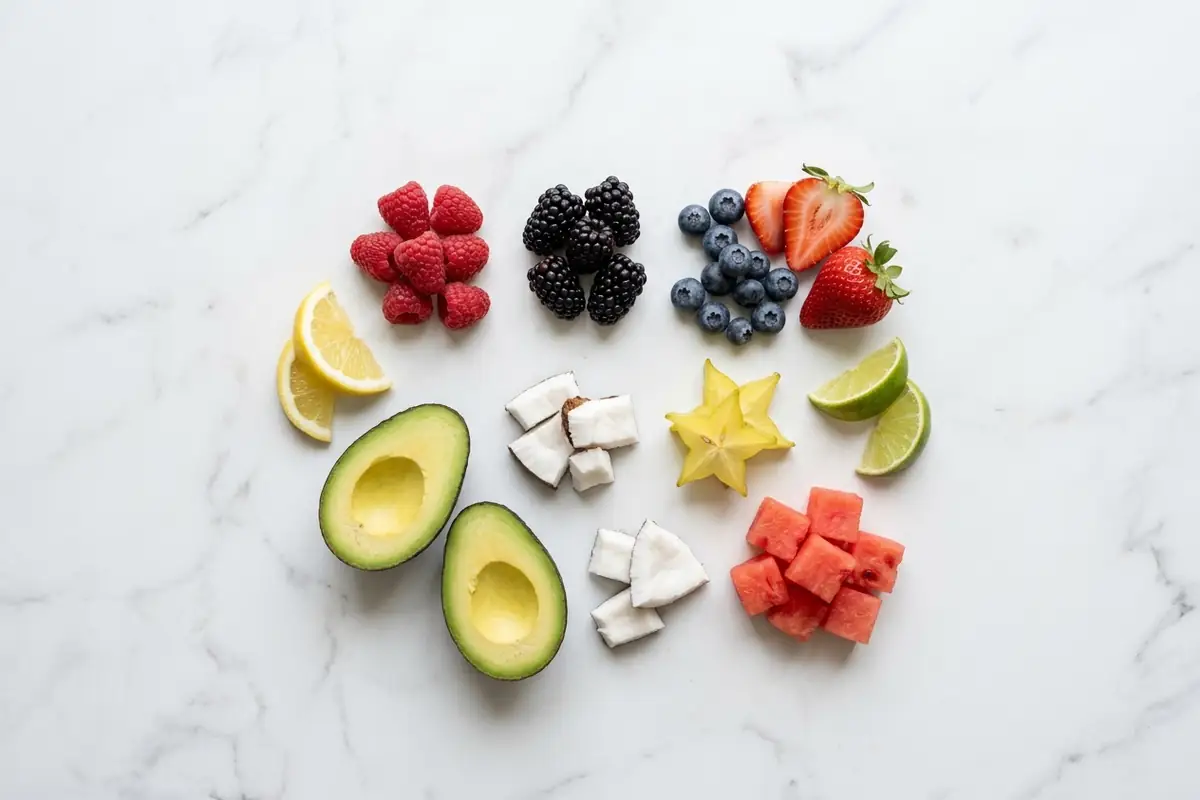
Here is the part the big lists get wrong. They print per-100-gram or per-cup numbers, then you scoop a real portion and the math no longer lines up. Below are net carbs at a serving you would genuinely put in a bowl. These are rounded, because brands and ripeness move them a gram or two either way.
| Fruit | Realistic serving | Net carbs |
|---|---|---|
| Olives | 10 olives | 1 g |
| Avocado | 1/2 medium | 2 g |
| Lemon or lime juice | 2 tbsp | 2 g |
| Blackberries | 1/2 cup | 3 g |
| Raspberries | 1/2 cup | 3 g |
| Strawberries | 1/2 cup sliced | 4 g |
| Star fruit | 1 cup cubed | 4 g |
| Watermelon | 1/2 cup cubed | 5 g |
| Cantaloupe | 1/2 cup cubed | 6 g |
| Blueberries | 1/2 cup | 9 g |
Notice blueberries. People treat them as a free berry because they are a berry, but at 9 grams for half a cup they are nearly triple the cost of raspberries. That single fact reorders most fruit bowls. For more on how ripeness shifts a berry’s sugar, recipe-testing outlets like Cooks Illustrated are worth a browse, which is why a late-summer pint tastes sweeter and counts a touch higher. The USDA FoodData Central database backs these net-carb figures if you ever want to verify a number against the official entry.
A quick note on varieties, because they move the math. Hass avocados run leaner in sugar than the larger Florida types. Among melons, honeydew counts slightly higher than cantaloupe, and casaba sits between them. Meyer lemons taste sweeter than standard Eureka lemons but carry similar carbs, so the sweetness is aroma, not sugar. Kalamata, Castelvetrano, and Manzanilla olives all land near 1 gram per ten, so pick by flavor, not by carbs. These small distinctions are the kind of detail that separates a real fruit plan from a generic allowed-foods list.
How one serving spends a 20 gram day
This is the framing nobody gives you, and it is the whole game. A strict keto day caps net carbs around 20 grams. Picture that as a wallet. Every fruit serving is a purchase. Here is what each one withdraws:
- 10 olives: 1 gram, 5 percent of the day. Pocket change.
- Half a cup of raspberries: 3 grams, 15 percent. Easy buy.
- Half a cup of strawberries: 4 grams, 20 percent. A fifth of your day on one small bowl.
- Half a cup of blueberries: 9 grams, 45 percent. Nearly half your budget, gone.
So the decision tree is short. If you have eaten low-carb all day and have 12 or more grams left, blueberries are fine and so is a small slice of melon. If you are already down to 6 grams, drop to raspberries or blackberries, which leave room for dinner. At 3 grams, olives or half an avocado are the better pick. The fruit changes based on what is left in the wallet, not on a fixed “always eat this” rule. That is the part the standard lists never teach, because they treat every fruit as a yes or no instead of a price tag.
A closer look at the berries that earn their spot
Berries carry the keto fruit list, so they deserve more than a number. Raspberries are the workhorse. Half a cup gives you 3 grams net carbs and a surprising amount of fiber, around 4 grams, which is why the net number stays low even though the total carbs look higher on a label. They freeze well, so a bag kept in the freezer door makes it easy to drop a frozen handful into yogurt, because frozen half-cup portions are easy to eyeball.
Blackberries match raspberries gram for gram and bring a deeper, less sweet flavor that works in savory dishes. Folded into a pan sauce for pork, their tartness cuts the fat the way a squeeze of lemon would. Strawberries sit a step higher at 4 grams per half cup sliced, and ripeness swings them more than any other berry, so a flat of June strawberries at peak sugar counts a little more than the same volume in March. Blueberries are the outlier, a point worth repeating because people keep forgetting it. They are delicious and they are expensive, 9 grams for half a cup, so treat them as a garnish, not a bowl. Ten blueberries on top of cottage cheese is 2 grams and reads as plenty.
One pairing that pulls its weight is berries with a fat. A few raspberries stirred into heavy whipped cream, sweetened with a little monk fruit or erythritol, turns 3 grams of fruit into a dessert that feels indulgent and keeps you full. The fat slows the small amount of sugar even further. That is the whole philosophy of the keto friendly snacks approach: pair the carb with fat or protein so it lands gently instead of spiking.
When in the day should you eat fruit?
Timing is the lever the standard lists ignore entirely, and it changes how much fruit you can get away with. If you eat fruit early, when you still have your whole carb budget open, you have all day to stay under the ceiling. If you eat it at 9 p.m. on top of a day that was already close to 18 grams, the same half cup of blueberries is what tips you over.
The other timing angle is activity. If you do anything physical, a walk, a workout, yard work, your muscles pull glucose out of your blood to refill, which gives a small fruit portion somewhere to go besides storage. One option is to eat the day’s larger fruit portion, if there is one, in the hour after exercise. It is not magic and it is not a license to double the serving, but it is the difference between fruit sitting in your budget and fruit getting used. None of this overrides the total. The day’s net carb number is still the boss. Timing just decides whether a given serving fits comfortably or scrapes the edge.
Craving swaps that keep you in ketosis
Most fruit failures are cravings, not ignorance. You want a banana. A medium banana is about 24 grams net carbs, which is an entire keto day in one peel. So instead of white-knuckling it, swap. Here is the named protocol, high-carb craving on the left, the in-budget answer on the right with the math:
- Banana (24 g) becomes 1/2 cup raspberries (3 g). You save 21 grams and still get the sweet-and-soft hit.
- Grapes (about 26 g per cup) become 10 olives plus a few strawberries (5 g total). The brine and the sweetness scratch the same itch.
- Apple (about 21 g) becomes 1/2 avocado with lemon and salt (3 g). Sounds odd, works.
- Mango (about 22 g per cup) becomes 1/2 cup blackberries (3 g) mashed into full-fat Greek yogurt.
The swap works because the brain wants the sensation, not the specific fruit. Cold, sweet, a little tart. Berries deliver that for a fraction of the carbs.
The strawberry on the counter test

Here is a habit that guards against the slow drift that knocks people out of ketosis. Before eating any fruit, do a five-second math check out loud. Strawberries on the counter: “half a cup, four grams, eleven left, yes.” If the number does not fit, either shrink the portion or skip it. No app, no scale, just the table above committed to memory.
It sounds fussy. It is not. After a week the numbers are memorized and the check becomes automatic. What it prevents is the ungated grab, the absentminded second handful that the lists never warn you about because they only tell you the fruit is “allowed.” Allowed and unlimited are not the same word. A handful of blueberries put on a scale can come to 70 grams, which is 9 grams of carbs, not the 3 a guess might suggest. That gap, repeated daily, is exactly how people stall. If you want a deeper system for keeping the whole day in range, the keto food list sorts every category the same way fruit is sorted here.
Two traps that look keto but are not
Dried fruit is the first. Drying removes water and concentrates sugar, so the carbs leap. Two tablespoons of raisins carry about 15 grams net carbs, because they are grapes with the water pulled out. A “healthy” trail mix with cranberries and apricots can hide 30 grams in a small scoop. Treat dried fruit as candy, because chemically that is what it is.
Fruit juice is the second. Juicing strips the fiber, which was the only thing making the fruit keto friendly, and leaves the sugar. Eight ounces of orange juice is roughly 26 grams net carbs with nothing to slow it down. Even “fresh squeezed” and “no sugar added” juices are pure fruit sugar in a glass. Whole fruit with its fiber intact behaves; the same fruit liquefied does not. Food outlets like Bon Appetit are a good general read on why whole fruit beats juice for blood sugar, and the logic carries straight over to keto. The principle is glycemic load: fiber and structure slow how fast sugar hits your bloodstream, and stripping either one speeds it up.
If you want the methodology behind every number in this guide, it is simple. The figures here take total carbs and fiber from the USDA FoodData Central entry for each exact item, subtract fiber from total, then scale to the serving you would actually eat. That is the same net-carb math America’s Test Kitchen and most registered-dietitian resources use, so the figures here line up with what you will find on a reputable label or database, not a guess.
If sweet cravings are your weak spot generally, it helps to have non-fruit options on deck too. The keto desserts roundup covers the ones that satisfy without the carb spike. For everyday grabbing, planning a few vegan bowls with berries folded in keeps fruit portioned by design instead of by willpower.
Reading a label so the number is real
Many fruit errors come from trusting a number on the front of a bag instead of the panel on the back. Frozen berries are the common culprit. A bag that says “no sugar added” can still list a serving as three quarters of a cup, and the carb count printed is for that larger scoop, not the half cup you meant to eat. Always pull the number back to your portion. If the label says 11 grams total carb and 5 grams fiber for three quarters of a cup, that is 6 grams net for that scoop, or 4 grams for a half cup. Do the division once and write it on the bag with a marker if you have to.
Watch the word “fruit” on processed foods, too. Fruit-flavored anything, fruit-on-the-bottom yogurt, fruit bars, fruit leather, all of it concentrates or adds sugar and counts far more than the whole fruit it is named after. A single cup of fruit-on-the-bottom yogurt can carry 30 grams of carbs, most of it from the fruit syrup, not the dairy. Plain full-fat yogurt with your own measured berries on top is a fraction of that and tastes better once you adjust.
Fruits to keep off the plate
For completeness, here are the ones that almost never fit a strict day. Banana (24 g), mango (22 g per cup), grapes (26 g per cup), pineapple (20 g per cup), apple (21 g), pear (22 g), and dates, which are sugar bombs at roughly 16 grams each. None of these are poison. They simply cost more than a 20 gram day can spend, so they live in the “special occasion, count it carefully, accept the stall” category. On a more relaxed 50 gram day you have more room, but even then a single banana is half your carbs.
There is also a middle tier worth naming so you are not caught off guard. Cherries, kiwi, and orange segments run 10 to 14 grams net carbs per modest serving. They are not in the off-limits pile and they are not everyday fruit either. They are “spend wisely” fruit. If you really want three or four cherries, count them, six cherries is about 6 grams, and adjust the rest of your day down to match. The honest framing keeps you from either banning a food you love or pretending it is free. Everything on keto is a tradeoff you can choose on purpose, and fruit is no different from any other carb you decide to spend on.
Frequently asked questions
Is watermelon keto?
Watermelon is keto in tiny portions only. Half a cup of cubes is about 5 grams net carbs, which fits, but the trouble is volume. Watermelon is mostly water and easy to overeat, and a normal three-cup helping pushes past 30 grams. If you serve it, pre-portion half a cup and put the rest away.
Can I eat berries every day on keto?
Yes, if you stick to a half-cup serving of raspberries, blackberries, or strawberries, which run 3 to 4 grams net carbs each. Blueberries at 9 grams per half cup are the one berry to ration. Daily berries are fine as long as they fit inside your total carb budget alongside everything else you eat.
Why is avocado called a keto fruit?
Avocado is botanically a fruit, and it is one of the best on keto because it is high in fat and fiber and low in sugar. Half a medium avocado is about 2 grams net carbs. It behaves more like a fat source than a fruit on your macros, which is exactly why it fits.
Does cooking fruit change the carbs?
Cooking does not create or destroy carbs, but it concentrates them when water cooks off. A reduced berry sauce has the same total sugar as the berries you started with, packed into a smaller volume, so a tablespoon counts more than you expect. Count the raw fruit you used, then divide by your portion of the finished dish.
How many net carbs from fruit can I have per day on keto?
There is no fixed fruit allowance, because fruit shares one budget with every other carb you eat. On a strict 20 gram day, many people cap fruit around 5 to 8 grams to leave room for vegetables and incidental carbs. The point is to fit fruit inside the total, not to give it a separate quota.
Are tomatoes keto friendly?
Tomatoes are keto friendly in normal cooking amounts. One cup is about 5 grams net carbs, and a few slices on a salad or a couple tablespoons of sauce barely register. Watch jarred sauces with added sugar, which can double the count, and read the label rather than trusting the word “marinara.”
What is the single lowest-carb fruit?
By realistic serving, olives win at about 1 gram net carbs per 10 olives, followed by avocado at 2 grams per half. If you mean berries, blackberries and raspberries tie near the bottom at 3 grams per half cup, which makes them the safest sweet fruit to eat often.