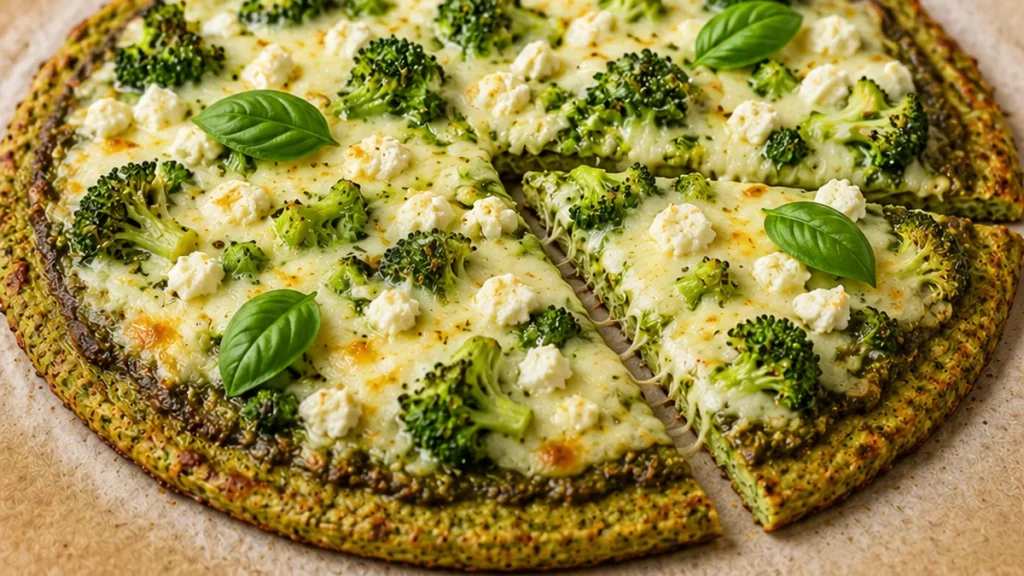
Craving pizza but sticking to a low-carb lifestyle? This pesto pizza is your answer! This recipe transforms simple vegetables into a satisfying, flavorful crust, topped with bright pesto and creamy cheeses. It’s proof that healthy eating can be incredibly delicious and doesn’t mean sacrificing your favorite comfort foods. Perfect for a weeknight dinner or a healthier weekend treat.
Key takeaways
- Thoroughly squeeze moisture from pre-cooked broccoli for a crisp crust.
- Ensure psyllium husk powder is fresh for optimal binding.
- Pre-bake the crust until firm before adding toppings.
- Adjust binders and moisture carefully if making substitutions.
Low-Carb Pesto Broccoli Pizza
Ingredients
- 9 ounce broccoli (chopped)
- 3 ounce onion (chopped)
- 3 teaspoon fresh garlic (peeled)
- 6 tablespoon almond flour
- 3 tablespoon psyllium husk powder
- 2 large egg
- 1 teaspoon salt
- 3 tablespoon pesto
- 1/2 cup mozzarella cheese (shredded)
- 1/3 cup feta cheese (crumbled)
Instructions
- Preheat oven to 375F (190C). Combine chopped broccoli, onion, and garlic in a food processor. Pulse until the mixture resembles coarse breadcrumbs.
- Add almond flour, psyllium husk powder, eggs, and salt to the food processor. Pulse until a dough forms. Scrape down sides as needed.
- Place dough on a parchment paper sheet. Top with another parchment sheet. Roll into a flat circle, about 1 to 1 1/2 cm thick.
- Transfer crust on parchment to a baking sheet. Bake for 12-15 minutes until firm and lightly browned. Remove from oven.
- Spread pesto evenly over the baked crust. Top with shredded mozzarella and crumbled feta cheese.
- Bake for another 8-10 minutes until cheese is melted and bubbly. Garnish with fresh basil and a drizzle of olive oil before serving.
Notes
The technique that makes it
The success of this low-carb pesto broccoli pizza hinges on two key techniques: properly preparing the broccoli and achieving the right crust consistency. First, the broccoli needs to be finely chopped or even pulsed in a food processor until it resembles coarse sand. This breaks down the fibrous structure, allowing it to bind effectively with the other crust ingredients. Pre-cooking the broccoli slightly, either by steaming or microwaving until tender-crisp, is crucial. This step releases moisture. If you use raw broccoli, the crust will become soggy and won’t hold its shape. After pre-cooking, it’s vital to squeeze out as much excess water as possible. Use a clean kitchen towel or cheesecloth to wring out the moisture; this is non-negotiable for a firm, pizza-like crust. The combination of almond flour and psyllium husk powder acts as the binder and structure for the crust, replacing traditional high-carb flour. Psyllium husk is particularly important as it absorbs liquid and creates a gel-like consistency, mimicking gluten‘s binding properties. Ensure the psyllium husk powder is fresh, as older powder may not absorb liquid as effectively. The eggs provide richness and further binding. When mixing, aim for a dough that is cohesive but not overly wet. Overworking the dough can make it tough. Pressing the dough evenly onto a parchment-lined baking sheet is essential for uniform cooking and crisping. A pre-baked crust is also key; baking it until golden brown and firm before adding toppings prevents a soggy bottom.
Troubleshooting
- Crust is too wet and sticky: This usually means not enough moisture was squeezed from the broccoli, or the psyllium husk powder is not absorbing enough liquid. Try adding a tablespoon more psyllium husk powder and letting it sit for 5 minutes. If still too wet, add a little more almond flour, one tablespoon at a time.
- Crust is crumbling and falling apart: Insufficient binder (eggs or psyllium husk) or not enough moisture in the broccoli. Ensure you used the correct amount of eggs and psyllium husk. If the broccoli was very dry, consider adding a tiny bit more egg or a tablespoon of water to the dough mixture.
- Soggy bottom crust: The broccoli likely contained too much moisture, or the crust was not pre-baked sufficiently. Ensure you thoroughly squeeze the cooked broccoli and pre-bake the crust until it’s golden and firm before adding toppings.
- Crust is too dense: Over-mixing the dough or using too much psyllium husk. Mix the ingredients just until combined. If using more psyllium husk than specified, it can lead to a dense texture.
Substitutions
- Almond Flour: Coconut flour can be used as a substitute, but use it sparingly as it is much more absorbent. You may need to adjust the liquid content. The texture will be slightly different, potentially drier.
- Psyllium Husk Powder: Ground flaxseed or chia seeds (1:1 ratio) can be used as binders. They will create a slightly different texture and may require a short resting period for the mixture to thicken. The crust might be a bit more crumbly.
- Broccoli: Cauliflower florets, finely chopped and processed, can be used instead of broccoli. Ensure you follow the same moisture-removal steps. The flavor profile will be slightly different.
- Mozzarella Cheese: A blend of other low-carb melting cheeses like provolone or Monterey Jack can be used. For a dairy-free option, use a good quality dairy-free shredded cheese alternative.
Pro tips
- Use a good quality, flavorful pesto for the best taste.
- For a crispier crust, pre-bake it a few minutes longer.
- Ensure broccoli, onion, and garlic are finely processed for the best texture.
- This pizza is best served immediately after baking.
Enjoy this flavorful and healthy pesto pizza guilt-free!
More from Keto Dinners & Mains →
Frequently asked questions
Can I use regular flour instead of almond flour?
No, this recipe is specifically designed for a low-carb, gluten-free crust using almond flour. Substituting with regular flour would significantly alter the carbohydrate content and texture, defeating the purpose of a low-carb pizza base.
How can I make the crust crispier?
To achieve a crispier crust, ensure you pre-bake it until it’s golden brown and firm. You can also try baking it directly on a pizza stone or baking steel, preheated in the oven, which helps distribute heat more evenly and drives off moisture.
What kind of pesto should I use?
Any good quality pesto will work. Traditional basil pesto is common, but you can also experiment with sun-dried tomato pesto or even a spinach-based pesto for a different flavor profile. Ensure it’s a low-sugar variety.
Can I prepare the crust ahead of time?
Yes, you can pre-bake the crust and let it cool completely. Store it wrapped tightly in the refrigerator for up to 2 days. Reheat it briefly in the oven before adding toppings to ensure it’s firm and ready.